
On the possibility of dying while adventuring
Five below Fahrenheit. Waning moon, clear sky, no wind. My mustache is growing a rind of ice. Yesterday, a polar wind blew down a proper cold out of the north and carried any bit of snow away that wasn’t frozen down or drifted up, with the result being roads and runways of sheer ice. I strap my rifle and pack into the back seat of the airplane and toss in a duffle with a tent, sleeping bag, and food; gear I do not plan to use.
We are going deer hunting. In a few minutes I will climb into a 1941 single-engine airplane, which has no lights, and take off in the dark. We will climb to six or seven thousand feet and fly over the Harding Ice Field on a flight lasting a little less than two hours. In these two hours, we will fly over one town and one airport, but everything else is mountains, glaciers, or water, none of which would accept a faltering tube-and-fabric airplane hospitably. The weathermen say that it should be nice where we are going, but the weathermen, bless their hearts, are generally unreliable for specifics. We will be landing off-airport, sloped beaches, likely with a good bit of wind. I am not nervous, but I am very awake.
I have two daughters, a toddler and an infant. One is doing a puzzle this morning, and considers that her life’s work, looking up to wave and then she’s back to work. The other is just learning to sit alone and slobber over toys. These girls are the most precious humans in my life now, and they call forth from me an energy and love I did not possess before they arrived. They have unlocked potential and emotion within me I did not know existed, they have awakened me.
This morning at breakfast Melanie says that when I’m off flying she thinks of newspaper headlines, such as FATHER OF TWO KILLED IN AIRPLANE WRECK, which is an unnecessary use of the imagination. I promise to turn on my location and give here regular updates, which eases her mind not at all. I also tell her the coast guard has helicopters that can find me in under two hours. She is still uneasy. I will have my satellite SOS device that can alert them immediately, and give them precise locations. Compared to the early aviators, we practically have flying ambulances and cell service.
“Most early aviators had lots of wrecks and just survived enough of them to be famous.” She said.
There is that.
Since my airplane does not have an electric starter, Jaden swings the prop for me. We will be flying together, him in his airplane, me in mine. The oil takes several minutes to warm because of the cold, and so as soon as my oil is warm enough I line up on the runway and push in the throttle and almost before the throttle is in I pull back on the stick and the airplane leaps into the air. With this dense air at 200 feet above sea level and five below, you almost can’t keep an airplane on the ground. There is pleasure in it.
A line of pink on the mountains. I put the nose on the horizon and let the airplane do its job, and by the time I’m over the mountains the altimeter reads seven thousand feet. The lakes and rivers show a scattering of fog that glow pale in the night. The sun begins to rise in the south—this is 60 degrees north latitude and it is December—and lighting up the mountains, obelisks of white turned to the sun and glowing pink. I can see forever up here, the city of Anchorage to the north, Prince William Sound to the south, vast ice fields and granite massifs below, visibility over a hundred miles. Some of the most formidable, but also some of the most beautiful, country in the world. How can these human emotions arrive simultaneously? Terror and beauty, opposite but dependent on each other, like good and evil, order and chaos, light and dark.
The tops of the glaciers are plains of white, and look like you could ski and drag your wheels in the powder for days. But it is all ice, and all ice is under pressure, and beneath those fields of white are crevasses so deep they could swallow an airplane. Some of the crevasses are open, and I can stare down into the blue abyss. Snow filters light, and blue is the only wavelength that pure snow will allow through. So blue snow caves are pure. Once the ice or snow becomes dirty, the cracks just go dark.
There are moments of sheer beauty and transcendence here. I look down and see my mortality; look up and feel immortality. I am safe, but feel the flimsy line between life and death, the fabric between me and a freezing wind, the 930 pound, air-and-fire, blood and thunder vehicle that takes you to seven thousand feet and give you a seat among the clouds.
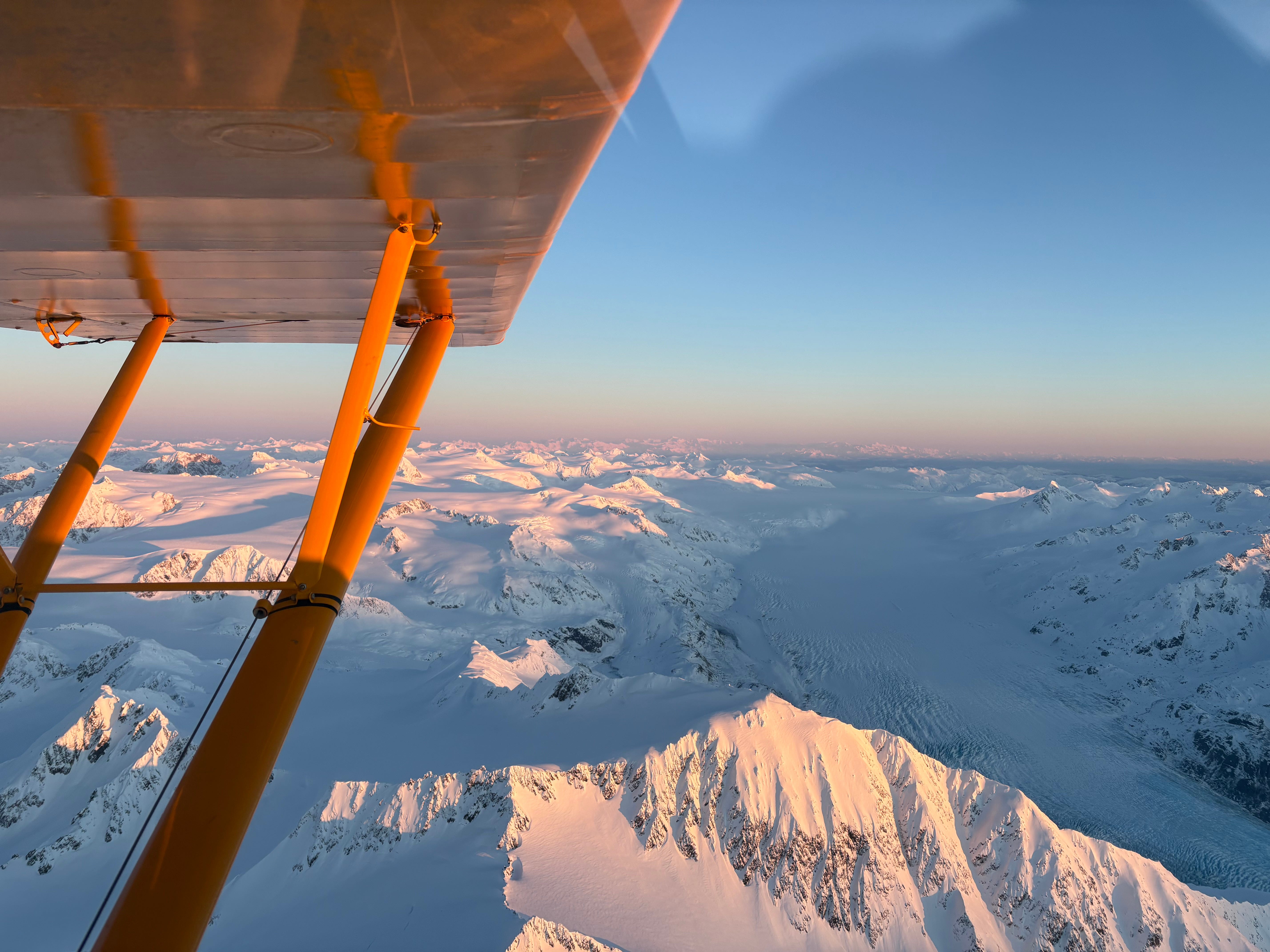
I do not mean to dramatize the risks involved with a trip like I am doing today, but they exist whether I face them or not. I am flying an 85-year-old museum piece over Alaskan mountains, in December, with short days, in weather that could change. I am a relatively inexperienced pilot, competent in this specific airplane perhaps but definitely without years of experience. There are some people who could do a trip like this and laugh at my nervousness, and some might say I am overly precious about my own existence. Why do you want save yourself so much?
There is another set of people who wouldn’t because It’s not safe. In the risk of litigation, hospitalization, liability, germs, diseases, risk, death, discomfort, skewered plans, safety becomes pathological mind-eater with its own –ism. Safety first, they said, as they batten down the cupboard doors and wipe down every flat service with hand sanitizer. We would rather live safely than rewardingly. Safetyism withholds our most intense experiences, our greatest achievements because it allows something that might happen stop us from what can happen.
We find a deer straightaway, and we have the deer quartered and in bags before noon. Sitka blacktails are not native to Prince William sound, and so they have overpopulated and in many instances, inbred. It is legal to fly and hunt the same day for these deer, so it makes a nice day hunt for extra venison in winter when things are slow.
The tide is coming in so we lift off and head home. Once over the mountains, I get some cell service and I get a text message from my dad: We changed our tickets because of the accident. Accident?
Turns out a friend’s mother was killed that morning in a highway accident, when someone simply drove into the side of their 1947 Studebaker while they were driving down Sparta highway in Tennessee.
Two days later, I would learn of an acquaintance in Texas who would have head-on collision and survive, although he would have a femur shattered in eight places, a crushed heel, a broken jaw and eye socket, a broken arm with bones shoved past each other, seat belt bruises, a cut head. A laundry list of injuries. He was just driving down the highway, staying in his lane, obeying the law.
Driving cars is also dangerous, and we all know this. We cluck our tongues at the dangers of sharing the roads with the drunks and loonies and then we drive to the funeral to offer condolences. We have accepted the risks of an automobile culture, have accepted that in our lifetime that a few of our friends will die on the highway. Nobody thinks of giving it up. Getting to the grocery store and the golf course is too important to be set aside for a small risk. But when someone parks an airplane on a glacier, the whole world knows about it and everyone thinks flying is “too dangerous,” even when they were going somewhere much more important than the golf course. (Like deer hunting.)
Much of this is also perceived risk, or felt risk. Flying airliners, for instance, is statistically much safer than driving, and yet many people refuse to fly for the felt risk of flying. People worry about bears when they go into the back country, and yet they probably are no more at risk there than on a morning run.
I will not pretend that single-engine airplanes are safer than cars. There is risk, both felt and unfelt, and anyone who pretends otherwise is deluding himself. It can be made safer by an aviator who practices much and is in the habit of paying attention to his machines and environment. Aviation generally punishes the sloppy, arrogant, and imprudent. A good place to start is to avoid these three attitudes, which, come to think of it, applies to more than aviation.
But the rewards run farther into the positive than the risks run to the negative. This morning, watching the sun rise over the mountains in the comfort of my warm airplane I struggle to imagine declining such an experience on the vague fear of something happening that probably won’t. How many people in the world get to do this? I used to read stories about people who did this, and now here I am. It’s unreal. Sometimes even the wildest childhood dreams come true and you don’t even realize it.
And what do we mean by safety? Is it even desirable? What does it get you? A long life? A merely safe and long life leaves no consideration for the quality of the same life. And we all know that the leading cause of death in America is not cars, airplanes, or sky diving, but poor dietary choices that lead to heart failure. Maybe, the riskiest thing to do is eat sugar on the couch, while the least dangerous is to do something like fly airplanes over glaciers. One dulls the senses and makes you lethargic, the other awakens you and makes you intensely alive and present.
If you take a moment and practice some attention while flying over a mountain range and feeling your mortality and the improbability of you being here and the ridiculousness of the whole enterprise, it shifts your nine-to-five perspective a little and puts it farther back than it was. When I get back to the house, my wife looks at me somewhat accusingly and says, “I knew you would come home happy.” That’s right. Like the famous line from the novel Lonesome Dove, “It ain’t dying I’m talking about. It’s living.”