
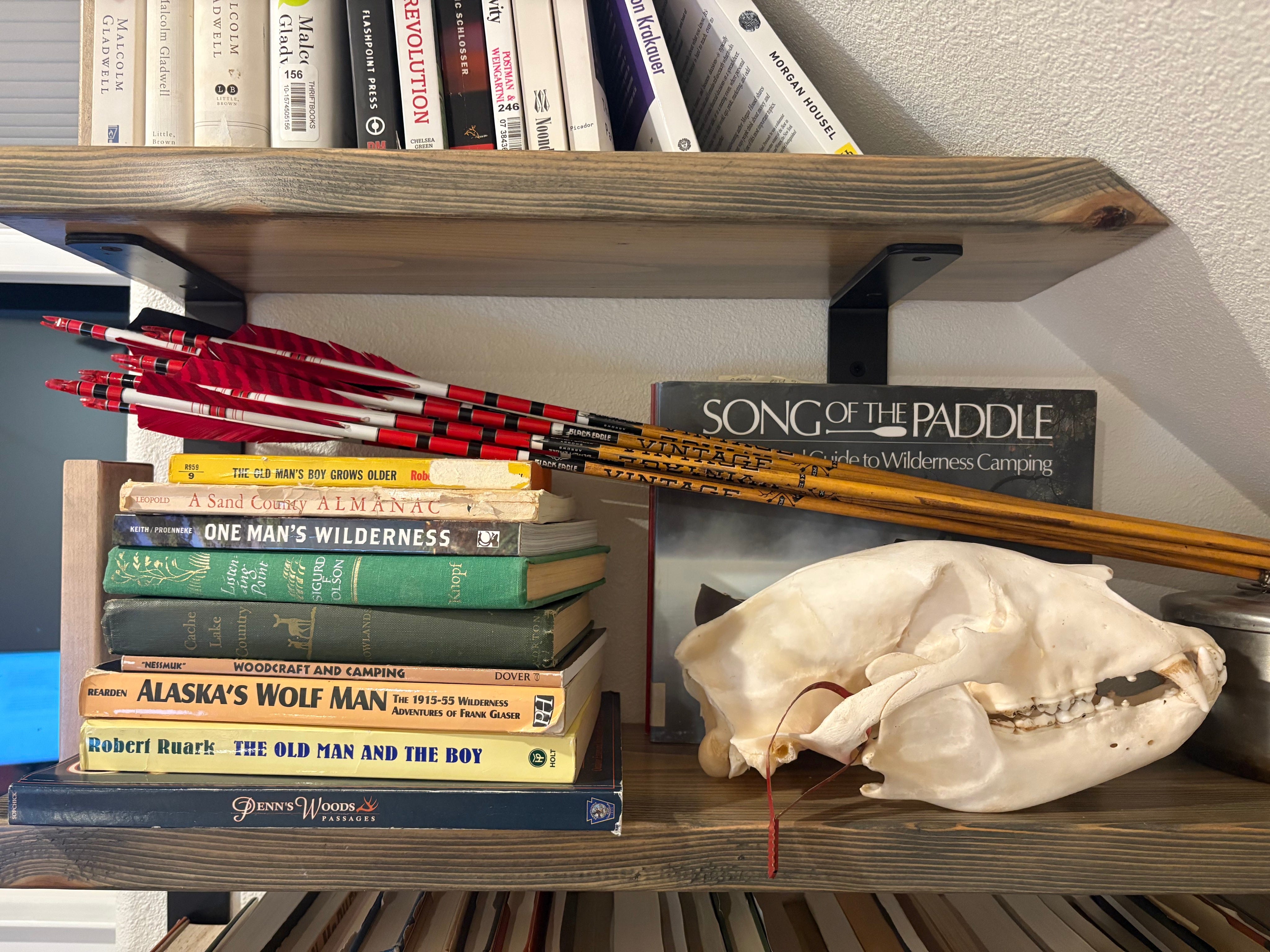
A writer and artist from York, Pennsylvania named Robert Sopchick singlehandedly made me want to be a writer. Sopchick wrote a column in Pennsylvania Game News, and it was a combination of naturalist’s sketchbook, woodland maunderings, and fiction with some mystical woo-woo. It was the business with the woo-woo that got me, the symbology and parallels, the magic of a deep forest. As a teen and pre-teen I would re-read his columns out of the tattered Game News we kept in a rack above the bureau while flopped across the bed on winter afternoons, then stand up and vow to be a “nature writer.” (Whatever that is.)
Who knows what shapes the formless and directionless mind of an adolescent? It must be either mentors or books, and quality mentors and books seems like the most important thing to have on hand for any teenager. Mentors can be found in books and mentor can hand out books, and so the conclusion is pretty straightforward; be a man worth imitating and give out good books. You just never know. Every boy needs to know a man worth imitating. But boys are reactionary about people explaining stuff, so it’s better to let books show them how other humans feel and live.
Certain phenomena burn themselves into the psyche of a child, and when he is old, he finds the sear marks of those experiences in his consciousness. Even after living among the mountains of Alaska, a Kentucky hardwood uplands in fading light will enchant the world again for me. You don’t forget the place where your mind awakens in, and books awakened me to home. It helped me see those woods. I only deliver this as a hope: Give boys books and maybe you can get to them before the iPhones do.
Cache Lake Country by John J. Rowlands
Rowlands lives somewhere in the canoe country in Canada on a lake nobody knows about. He writes about making biscuits wrapped around a stick, catching grayling from a birch bark canoe, calling moose, the song of loons on a foggy lake, making birch bark candles, training his dog, making peach cobbler in a Dutch oven. All of these are accompanied with diagrams and hand drawn pictures of his adventures and exploits.
The Old Man and the Boy and The Old Man’s Boy Grows Older by Robert Ruark
Robert Ruark only wrote two family-friendly books, and they are the Old Man and the Boy and its big brother, The Old Man’s Boy Grows Older. Originally published in the magazine Field and Stream as stand-alone pieces, these stories fictionalize Ruark’s own childhood with his maternal grandfather who introduces him to ethics, how to handle a gun, and how to be a thoughtful conservationist. The old man is cranky, and likes to drink, and is given to random bouts of apostrophizing his protégé. It is lovely, and if you skip any other books I mention, please don’t skip this one. Reading The Old Man and the Boy is almost as good as being in the woods.
Woodcraft by George Washington Sears or “Nessmuk”
Woodcraft may be the original backpack camping guide. George Washington sears wrote for Field and Stream in the 1880’s under the pseudonym “Nessmuk.” The original camping minimalist, he tells you what you need and what you don’t. How to take enough to camp well but not have a heavy pack, and how skill is more important than gear. Dated as most of his advice is, the principles still apply to a modern camper. When he talks about spending three days traveling to a distant blacksmith to have the blacksmith build him a custom camping axe that is only a little lighter, you know the ounce-counting mountaineers of today were born then.
One Man’s Wilderness by Dick Proeneoke
In the late 1960’s, Dick Preoneoke decided to go live alone in the Alaskan wilderness. A friend flew him to Twin Lakes in the Alaska range, where he built a cabin with an axe and a saw. He built the hinges for his door, the latch, everything, by hand, out of wood, and with a minimum of purchased goods. One Man’s Wilderness is Preoneoke’s diary as he made his living in the woods. He also filmed himself building and living at his cabin, and this has been made into a movie. His cabin is still there, still maintained and has been added to the national register of historic places. For anyone interested, you can charter a float plane flight out there to take a look at it.
Alaska’s Wolf Man by Frank Glaser
One of the original great mountain men of Alaska, Frank Glaser lived alone in a cabin in the Alaska range. He walked, and trapped wolves for the government and had wolf dogs for friends. Mostly, he walked, and could do 40 miles to town over mountains and rivers and consider it a grocery run. A classic tale of early Alaska and the daily life we would consider suffering today.
Listening Point by Sigurd Olson
Sigurd Olson, living in Ely, Minnesota, which is close to the “boundary waters” or the Quetico-Superior country, is now figurehead in conservation. His books are mostly stand-alone pieces written about experiences in the wild, gathering wild rice and watching ducks and paddling his canoe. He built a cabin overlooking a quiet lake where he then dubbed “Listening Point.” That cabin still stands, and is the hub of the Listening Point Foundation, a group dedicated to the conservation of the lakes and canoe routes around Ely, Minnesota. There are more books of the same sort, an observant writer spending time alone.
A Sand County Almanac by Aldo Leopold
Now, of course, this is not necessarily a boy’s book, but it can be, and the earlier you can introduce a boy to it, the better. It has gorgeous nature writing in it, but that is not the point of the book. It has in it some of the landmark essays of conservation and love of wilderness, and I read it from time to time to open my eyes to the world around me. Enough said. Aldo Leopold’s farm is now home to the Aldo Leopold Foundation, and his shack still exists, there along the Wisconsin river, if you want to make the book become even more alive.
Penn’s Wood Passages by Bob Sopchick
In the last couple years as Robert Sopchick was suffering of ALS, he gathered many of his writings, drawings, and paintings into a book titled Penn’s Wood Passages. You can’t find it just anywhere, as they seem to be self-published with a limited run. Rereading Sopchick’s writing now, I don’t have the same reaction I did as a twelve year old, which is normal. In any regard, I owe Sopchick a huge debt for cracking open the woods for me and showing me the mystery of a crow or giving me an image of a blue mountain or a whitetail sneaking through the rhododendron. I will never forget the feeling those stories produced in me while flopped across the bed on winter afternoons.
I’m sure there are more books, but that’s the list I can recommend for young men. Instead of having a shelf lined with collectible vintage tractors, like a Midwest grandpa might, I plan to have a shelf lined with old wilderness camping, canoeing, and hunting guides, artifacts of my childhood dreams. Because if it wouldn’t have been for those books and probably a mentor or two, I would probably be a basement dwelling cyberpunk, which I fail to see as preferable.
Do you have any more recommendations in this genre? Please drop them in the comments below. Thank you!